![firefly_logo_FINAL [Black].jpg](https://images.squarespace-cdn.com/content/v1/5411d5c0e4b02e1c8b27565a/1434491508803-XB4OF7YDY46Z72L5U5AP/firefly_logo_FINAL+%5BBlack%5D.jpg)
When Atoms Start Acting as One: Inside Bose-Einstein Condensates (BEC) and the Cells That Make Them Possible
/Most glass cells do not get to participate in creating an entirely different state of matter.
Bose-Einstein Condensate (BEC) cells do.
Inside these specialized vacuum cells, researchers can cool collections of atoms to extraordinarily low temperatures, eventually reaching conditions where something remarkable happens. Instead of behaving like a collection of independent particles, a large number of bosons can occupy the same quantum state, allowing quantum behavior to emerge on a scale researchers can directly study.
Welcome to the wonderfully strange world of the Bose-Einstein condensate.
BEC experiments sit at the intersection of atomic physics, quantum optics, precision measurement, quantum sensing, and fundamental physics. They also place some unusual demands on the glass or quartz chamber at the center of the experiment.
That is where FireflySci comes in.
FireflySci manufactures custom Bose-Einstein Condensate (BEC) cells, MOT cells, UHV cells, and specialized optical cells for researchers whose experiments have officially graduated beyond anything you are likely to find sitting on a laboratory supply shelf.
So, how does a BEC work, why does the cell matter, and what does it take to build one?
Let's get cold.
What Is a Bose-Einstein Condensate?
A Bose-Einstein condensate, or BEC, is a state of matter that can form when a dilute gas of bosonic particles is cooled to extremely low temperatures.
And when we say cold, we mean cold.
Temperatures in BEC experiments can reach the nanokelvin regime, just fractions of a degree above absolute zero.
As the gas becomes colder, the atoms move more slowly. Eventually, their quantum-mechanical wave nature becomes increasingly important. At sufficiently low temperatures and high phase-space density, a large fraction of the atoms can occupy the same lowest-energy quantum state.
At that point, treating every atom as a completely independent particle stops being particularly useful.
The collection begins displaying collective quantum behavior.
That is the magic of a BEC.
It gives researchers an opportunity to investigate quantum-mechanical phenomena using clouds containing thousands, millions, or even more atoms.
who’s the bose?
Bose, Einstein, and a Prediction That Took 70 Years to See
game recognizes game.
The theory behind Bose-Einstein condensation dates back to the 1920s.
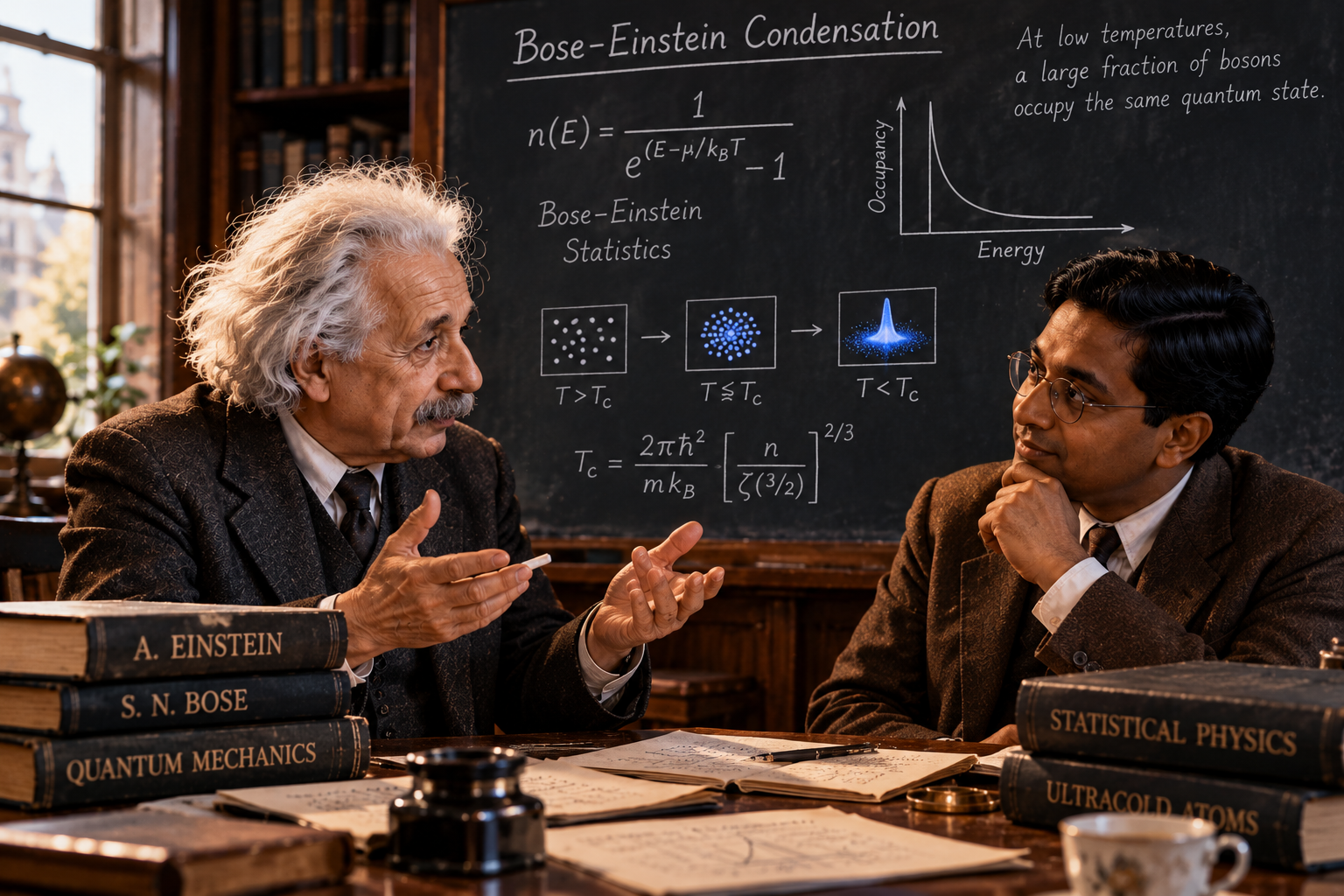
Indian physicist Satyendra Nath Bose developed a new statistical treatment of photons. Albert Einstein recognized the importance of Bose's work and extended the underlying statistics to massive particles.
The theory predicted that at sufficiently low temperatures, particles obeying what became known as Bose-Einstein statistics could accumulate in the same quantum state.
There was just one little problem.
Nobody could make a gas cold enough to see it.
That changed in 1995, when Eric Cornell, Carl Wieman, and their team at JILA created the first gaseous Bose-Einstein condensate using rubidium-87 atoms.
The first BEC contained roughly 2,000 atoms and was only about 20 micrometers across.
And where did this new state of matter appear?
Inside a glass cell.
More on that in a minute.
How Do You Make a Bose-Einstein Condensate?
There is no single universal BEC apparatus. Different laboratories use different atomic species, vacuum systems, trap geometries, laser arrangements, and cooling strategies.
But a simplified BEC experiment often follows a progression that looks something like this.
Step 1: Start With an Atomic Gas
Researchers first need a source of atoms.
Rubidium is particularly common in BEC research, although sodium, lithium, potassium, strontium, and other atomic species are also used.
The atoms are introduced into a vacuum system where researchers can begin controlling them without constant collisions with ordinary air molecules.
That brings us to one of the most important ingredients in the experiment.
Vacuum.
A lot of vacuum.
Step 2: Capture the Atoms With a Magneto-Optical Trap
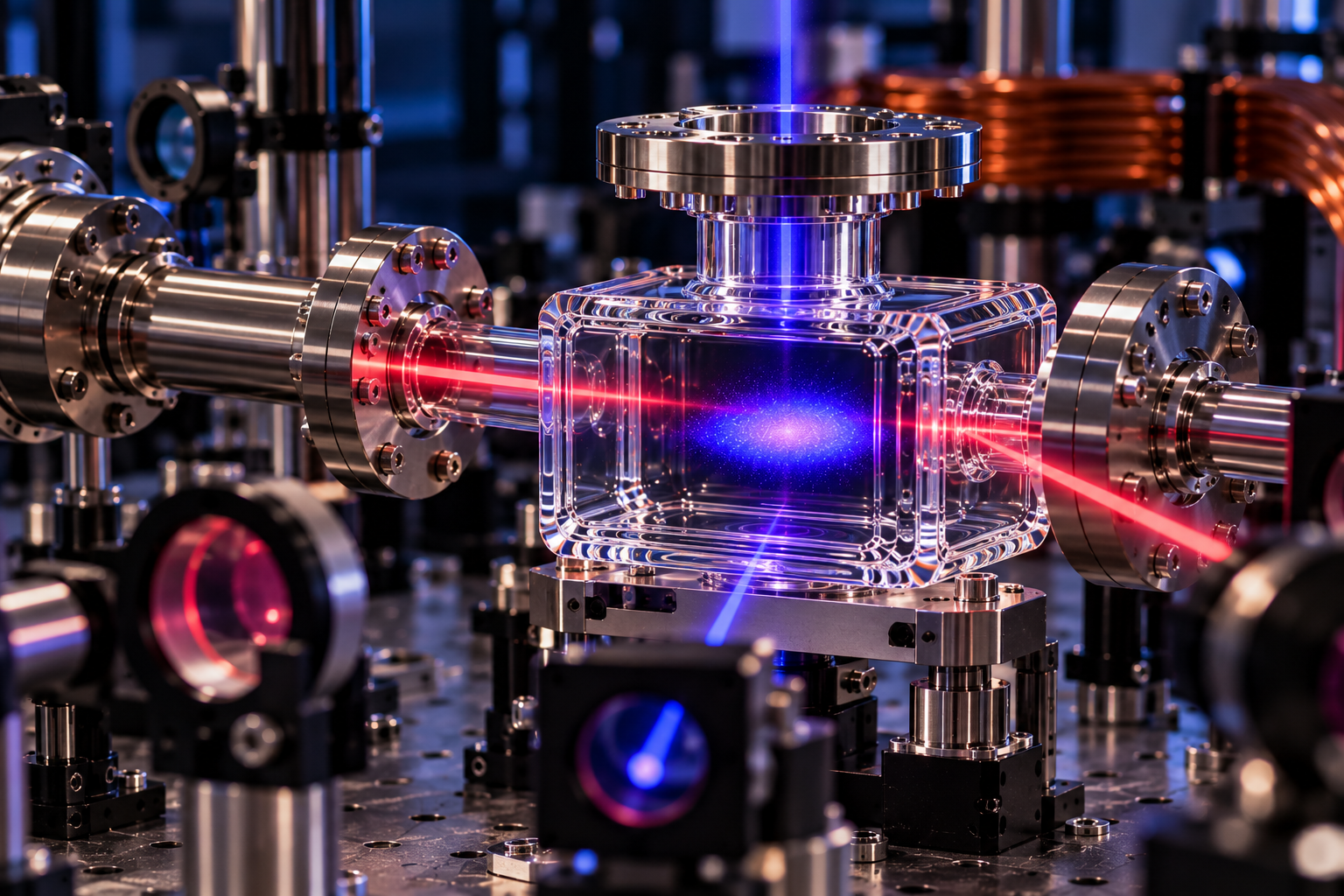
A magneto-optical trap, or MOT, is frequently one of the first major cooling stages in a BEC experiment.
A MOT typically combines red-detuned laser beams with a spatially varying magnetic field. The laser light reduces atomic velocity while the magnetic field helps produce a restoring force that confines atoms around the center of the trap.
The result is a cloud of cold atoms.
Cold, however, is relative.
A MOT can get atoms extraordinarily cold by everyday standards, but creating a BEC usually requires pushing the temperature substantially lower.
Step 3: Transfer the Atoms
Some BEC systems perform multiple stages of the experiment inside one chamber.
Others use separate chambers.
For example, a larger MOT cell may be optimized for capturing a substantial number of atoms. Those atoms can then be transferred through the vacuum system into a smaller science cell, where the final cooling stages and experiments occur.
This separation allows researchers to optimize different parts of the vacuum system for different jobs.
The MOT wants lots of atoms.
The science chamber wants exceptionally clean vacuum conditions, strong optical access, and precise control.
Getting both simultaneously can be tricky.
Step 4: Keep Cooling
After initial laser cooling, atoms can be transferred into magnetic or optical traps for further cooling.
One widely used technique is evaporative cooling.
The concept is somewhat similar to cooling a cup of coffee through evaporation. The highest-energy atoms are selectively allowed to escape the trap. The remaining atoms collide and redistribute their energy, lowering the temperature of the sample.
Repeat the process, and the remaining cloud becomes progressively colder.
Eventually, the system can cross the threshold into Bose-Einstein condensation.
Step 5: A BEC Appears
As the temperature falls and the phase-space density increases, a significant fraction of the bosonic atoms can begin occupying the same quantum state.
The result is the BEC.
Researchers can then manipulate, release, image, split, interfere, transport, or otherwise experiment with the condensate.
Which is where things get really interesting.
What Is a Bose-Einstein Condensate Cell?
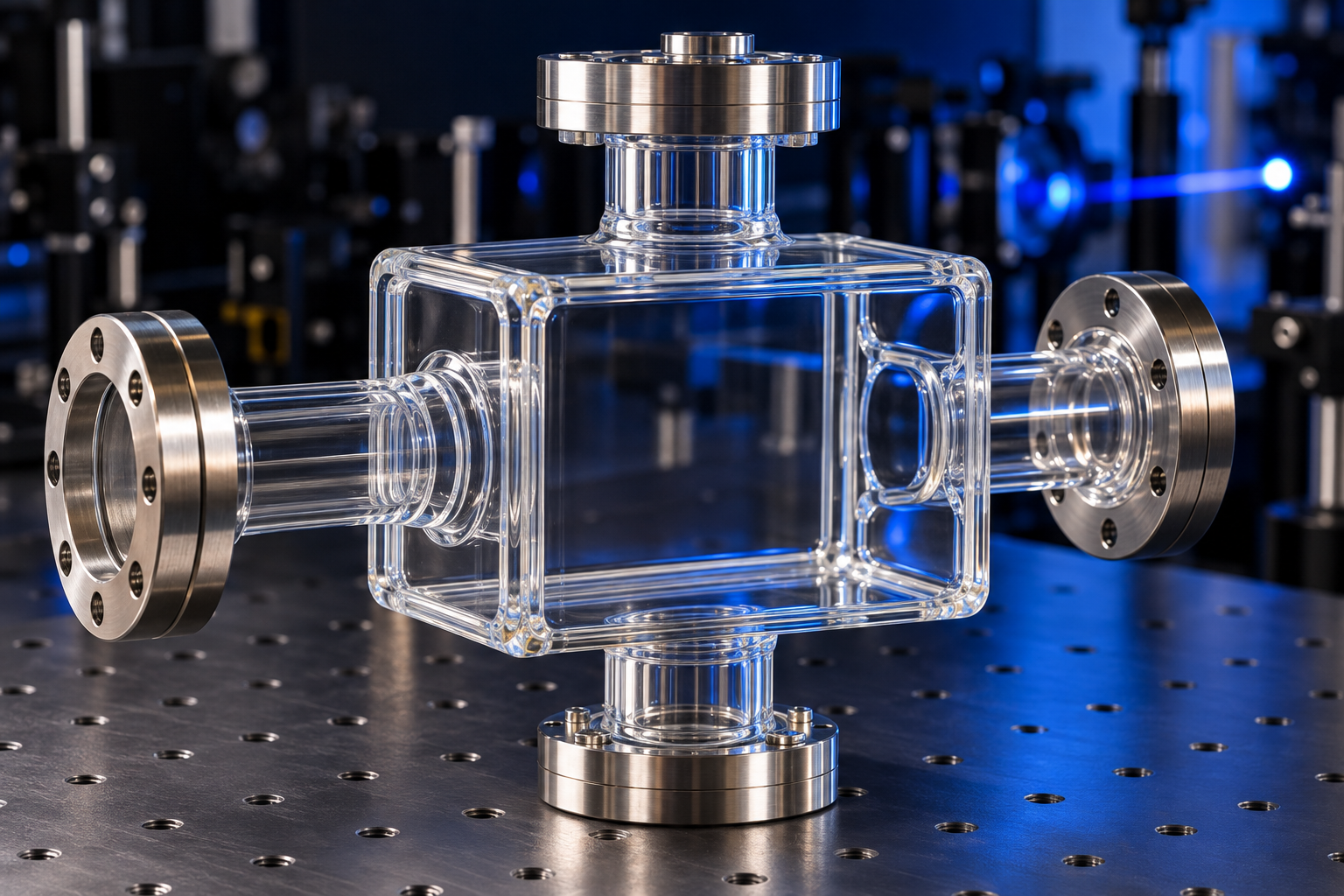
A BEC cell is the optical vacuum chamber where some or all of the cooling, trapping, condensation, manipulation, and imaging stages of a Bose-Einstein condensate experiment take place.
Depending on the apparatus, you might also hear terms such as:
BEC vacuum cell
BEC science cell
BEC-MOT cell
Ultracold atom cell
Cold atom vacuum cell
Quantum optics cell
UHV glass cell
MOT-BEC chamber
The exact design can vary dramatically.
Some BEC cells are relatively simple rectangular glass chambers. Others use multiple windows, specialized tubes, graded seals, CF flange connections, octagonal geometries, or other custom configurations.
There is a reason for all that customization.
The cell is not merely a container.
It is part vacuum chamber, part optical component, and part interface between a collection of highly specialized experimental systems.
Why Does a BEC Cell Need Ultra-High Vacuum?
If you are trying to maintain a delicate cloud of ultracold atoms, random collisions are not your friend.
Atoms and molecules from the surrounding environment can collide with trapped atoms, transferring energy and ejecting them from the trap.
That means BEC experiments typically need extremely low background pressures.
Depending on the experiment, pressures in the science region can reach the 10⁻¹⁰ to 10⁻¹¹ Torr range or lower.
At these pressures, collisions with background gas become infrequent enough to provide the trap lifetimes needed for cooling and experimentation.
The glass cell therefore has to become an integral part of an ultra-high-vacuum system.
That affects practically everything about its design, including material selection, seals, connections, surface cleanliness, manufacturing processes, geometry, and how the finished cell connects to the rest of the vacuum apparatus.
FireflySci already specializes in optical cells built for demanding vacuum environments.
Our stock UHV cells provide examples of quartz-to-Pyrex and metal-to-Pyrex graded-seal constructions designed for high-vacuum applications.
You can explore them here:
https://www.fireflysci.com/uhv-cells
For BEC research, however, the required geometry can quickly become much more specialized.
That is where custom manufacturing enters the picture.
Optical Access: When Your Vacuum Chamber Also Needs to Be an Optical Component
Creating the vacuum is only half the battle.
Researchers also need to get light into and out of the chamber.
A lot of it.
A BEC experiment can involve MOT beams, imaging beams, optical pumping beams, dipole-trap beams, push beams, repump beams, probing light, and other optical pathways.
Suddenly that little glass box is surrounded by an impressive amount of equipment.
The optical surfaces of the BEC cell therefore matter.
Depending on the experiment, researchers may need to consider:
Window flatness
Parallelism
Surface quality
Optical transmission
Laser wavelength
Reflections
Beam distortion
Scattering
Window dimensions
Optical path position
Imaging geometry
Working distance
Distance between the atoms and cell wall
This is also why rectangular, square, octagonal, and other multi-window geometries can be attractive for cold atom research.
The goal is not simply to see inside the chamber.
The goal is to interact with the atoms inside it from precisely the right directions.
A BEC Cell Can Be Very Different From a MOT Cell
MOT and BEC cells are closely related, but the terms should not always be treated as interchangeable.
A MOT cell is primarily associated with the magneto-optical trapping stage.
A BEC science cell may be optimized for later stages of the experiment, including evaporative cooling, optical or magnetic trapping, manipulation, and imaging of the condensate.
Some systems combine these functions into a single chamber.
Others separate them.
One example comes from the Bose-Einstein Condensation Lab at the University of Arizona. Its experimental system has used two glass cells. A larger MOT cell was used to laser-cool more than one billion rubidium atoms, while a smaller science cell was used for the evaporation stage that produced the BEC and for subsequent interaction with imaging beams and other experimental parameters.
The atoms were magnetically transported between the two regions.
This demonstrates why calling FireflySci with nothing more than "I need a BEC cell" might be the beginning of the conversation rather than the end.
We need to know what the cell is actually going to do.
BEC Cell Materials: Borosilicate, Quartz, and Fused Silica
Material selection depends on the requirements of the experiment.
Borosilicate Glass
Borosilicate materials can provide a useful combination of fabrication flexibility, optical performance, and thermal properties.
They can be particularly useful when a design requires glassblown components, tubulations, vacuum connections, or transitions to other materials.
Fused Silica and Quartz
Fused silica may be desirable when researchers require excellent optical properties, UV transmission, low thermal expansion, or specialized optical performance.
FireflySci has extensive experience manufacturing precision optical cells from quartz and fused silica, along with borosilicate and graded-seal constructions.
For a custom BEC cell, material selection should be driven by the actual experiment.
The questions we want to know include:
What wavelengths are you using?
What vacuum level are you targeting?
Does the system need to be baked?
What flange or vacuum connection is required?
How close do your atoms need to be to a particular window?
What imaging resolution are you trying to achieve?
How much physical space is available between coils?
Once those questions start getting answered, the correct cell begins taking shape.
BEC Experiments That Show Just How Important the Cell Can Be
Bose-Einstein condensation has gone from an exotic laboratory achievement to an experimental platform used throughout modern atomic physics.
And glass cells have been along for quite a bit of that journey.
The First Bose-Einstein Condensate
On June 5, 1995, the JILA team led by Eric Cornell and Carl Wieman produced the first gaseous Bose-Einstein condensate.
The team used laser and magnetic traps to cool rubidium atoms until roughly 2,000 atoms formed a condensate.
The BEC was created inside a carrot-sized glass cell surrounded by lasers, magnets, and laboratory equipment.
That tiny cloud helped open an entirely new area of experimental atomic physics.
Not bad for a day's work inside a glass cell.
Two Glass Cells for Rubidium BEC Research
The University of Arizona's Bose-Einstein Condensation Lab provides another great example of why custom cell geometry matters.
Its apparatus has used a larger glass MOT cell to capture and initially cool rubidium atoms, followed by magnetic transport into a smaller glass science cell.
The science cell operates at extremely low pressure and provides the environment where evaporative cooling and subsequent BEC experimentation can occur.
This type of architecture highlights an important point: sometimes the ideal BEC apparatus is not one cell.
It is an interconnected vacuum system containing multiple cells optimized for different stages of the experiment.
Creating BECs in Space
Then somebody decided Earth was making things too easy.
NASA's Cold Atom Laboratory (CAL) launched to the International Space Station in 2018 and became the first facility to create Bose-Einstein condensates in Earth orbit.
Why take BEC research to space?
Gravity.
On Earth, gravity affects how an ultracold atomic cloud expands and evolves after its trap is weakened or released. In microgravity, researchers can investigate the condensate over longer free-evolution times and under conditions difficult to reproduce in terrestrial laboratories.
The Cold Atom Lab has worked with ultracold rubidium and potassium atoms and is operated remotely from NASA's Jet Propulsion Laboratory.
The science module brings the vacuum system, lasers, magnetic trapping hardware, electronics, and other equipment needed for ultracold atom research into an extraordinarily compact package.
It is a spectacular example of how far BEC experiments have come since 1995.
From a tabletop glass cell to orbit in a little over two decades.
Continuous Bose-Einstein Condensation
BEC research continues to evolve.
Researchers have also demonstrated continuous Bose-Einstein condensation, rather than treating BEC creation solely as a repeated batch process.
One experimental approach using strontium continuously feeds laser-cooled atoms from a steady-state MOT into a reservoir and a deeper "dimple" trap. Cooling, replenishment, and condensation can then occur continuously.
Experiments like this illustrate how sophisticated cold atom systems are becoming and why the vacuum chamber must be considered as part of a complete optical and mechanical system rather than an isolated component.
What Can FireflySci Customize on a BEC Cell?
This is the fun part.
BEC experiments tend to be highly specialized, which means a stock vacuum cell may be perfect for one laboratory and completely useless for the one next door.
FireflySci can manufacture custom BEC cells and related UHV optical cells around the requirements of the experiment.
Depending on manufacturing feasibility, customization can include:
Cell length, width, and height
Rectangular or specialized chamber geometries
Optical window dimensions
Optical window locations
Wall thickness
Quartz or glass material selection
Tubulations
Vacuum connections
Graded seals
Metal-to-glass transitions
CF flange integration
Custom optical paths
Specialized window arrangements
Designs based on customer drawings
Modifications based on existing cell geometries
The most important word here is custom.
A BEC cell should be designed around the optical table, coils, vacuum system, laser geometry, imaging system, and experiment it is going into.
Not the other way around.
What Should You Consider When Designing a Custom BEC Cell?
If you are preparing a drawing or RFQ for a custom Bose-Einstein Condensate cell, more information is almost always better.
SpecificationWhy It MattersCell geometryDetermines optical access and integration with the experimentInternal dimensionsDefines usable experimental volumeExternal dimensionsAffects coil spacing and surrounding hardwareMaterialInfluences optical, thermal, and fabrication propertiesLaser wavelengthsHelps determine optical material requirementsWindow locationsDetermines beam and imaging accessDistance to atom cloudCan be critical for imaging and field generationVacuum levelInfluences construction and connection requirementsVacuum connectionDetermines integration with pumps and other chambersBakeout requirementsCan affect material and joining choicesTubulationsConnect atom sources and vacuum componentsOptical requirementsHelps define surfaces, transmission, and coatingsMechanical restrictionsEnsures the finished cell actually fits into the apparatus
And please send a drawing whenever possible.
CAD drawings are fantastic.
Dimensioned sketches are fantastic.
A carefully labeled napkin drawing can still tell us quite a bit.
Why Put the Atoms Close to the Glass?
Another design consideration in some BEC experiments is the distance between the trapped atoms and the cell wall.
Smaller science cells can allow magnetic coils, atom chips, objectives, and other experimental hardware to sit closer to the atomic cloud.
That can matter for generating strong magnetic-field gradients or achieving high-resolution imaging.
But making a chamber smaller also introduces tradeoffs.
Researchers still need adequate optical access, vacuum conductance, mechanical strength, manufacturing tolerances, and room for whatever beams need to pass through the experiment.
This is exactly why BEC cell design becomes an exercise in balancing requirements rather than simply picking a chamber size.
BEC Cells and Atom Chips
Some modern BEC experiments combine ultra-high-vacuum glass cells with atom chips.
These systems use microfabricated conductors and structures to generate highly localized magnetic or electromagnetic potentials near the atomic cloud.
Rubidium BEC experiments have, for example, loaded laser-cooled atoms into an ultra-high-vacuum glass science cell containing an atom chip, initially capturing the atoms with a MOT before transferring them into magnetic microtraps and using evaporative cooling to reach quantum degeneracy.
For these systems, chamber geometry becomes especially important because researchers may need to balance optical access with extremely short distances between the atoms and chip surface.
Once again, the humble glass cell is doing considerably more work than its appearance suggests.
What Are Bose-Einstein Condensates Used to Study?
Creating a BEC is impressive.
But for most research groups, creating it is only the beginning.
BECs have become experimental tools for investigating subjects including:
Quantum mechanics
Matter-wave interference
Atom interferometry
Superfluidity
Quantum simulation
Quantum sensing
Precision measurement
Atom optics
Atomic interactions
Quantum phase transitions
Optical lattices
Many-body physics
Fundamental tests of physics
Researchers have also developed atom lasers, where coherent matter waves are extracted from a BEC in a concept loosely analogous to extracting coherent light from an optical laser.
And as the Cold Atom Laboratory demonstrates, ultracold atom research is increasingly being investigated for precision sensing and space-based quantum experiments.
A tiny cloud of extremely cold atoms can make a surprisingly capable laboratory.
Why Glass Cell Geometry Matters So Much
There is a recurring theme in BEC apparatus design:
Everything wants to occupy the same space.
The lasers need optical access.
The magnetic coils need to get close to the atoms.
The imaging objective wants a clear view.
The vacuum connection has to go somewhere.
The atom source needs access.
The pump needs adequate conductance.
The optical table is already full.
And the atoms, naturally, need to end up exactly where everything intersects.
This is why custom BEC cells can range from simple rectangular chambers to multi-window and multi-port designs.
A few millimeters in the wrong direction can interfere with a coil, clip a laser beam, restrict an imaging path, or make mounting unnecessarily difficult.
Custom manufacturing lets the chamber become part of the apparatus design from the beginning.
Looking for Something Simpler? Start With FireflySci UHV Cells
Not every cold atom or vacuum experiment requires a completely custom chamber.
FireflySci also offers stock UHV cells designed for experiments requiring specialized high-vacuum optical access.
Our available configurations include quartz-to-Pyrex and metal-to-Pyrex graded-seal designs in multiple optical path configurations.
You can explore our stock options here:
https://www.fireflysci.com/uhv-cells
These cells may work directly for certain vacuum experiments or provide a useful starting point when discussing a more specialized configuration.
If your requirements go beyond our catalog, that is when we start talking custom.
Custom Bose-Einstein Condensate (BEC) Cells From FireflySci
A Bose-Einstein Condensate cell may look simple sitting by itself.
Put it into an actual experiment and the picture changes quickly.
Now it has to maintain ultra-high vacuum while providing precisely positioned optical access for lasers and imaging systems. It may need to sit between magnetic coils, connect to pumps and atom sources, accommodate unusual wavelengths, withstand vacuum processing, and fit into a laboratory setup where every millimeter has already been claimed by something else.
That is exactly the type of challenge custom scientific glass manufacturing is built for.
FireflySci has extensive experience manufacturing precision quartz, fused silica, borosilicate, graded-seal, vacuum, cryogenic, and custom optical cells for demanding research applications.
Whether you need a relatively straightforward rectangular science cell or a completely custom BEC-MOT chamber designed around an existing experimental setup, send us the specifications.
Dimensions help.
Materials help.
Laser wavelengths help.
Vacuum requirements help.
Drawings really help.
We'll work with you to determine how the cell can be manufactured around the needs of your experiment.
Ready to Build Your BEC Experiment?
When you're trying to persuade thousands of atoms to stop acting like individuals and start behaving as a single quantum system, there are already enough variables to worry about.
Your cell does not need to be another one.
Send FireflySci your drawings and requirements for a custom Bose-Einstein Condensate (BEC) cell, MOT-BEC cell, science cell, or related UHV optical chamber.
Or, if your experiment can work with an existing configuration, take a look at our stock UHV cells here:
https://www.fireflysci.com/uhv-cells
From the first rubidium condensate in a small glass chamber to BEC experiments orbiting hundreds of kilometers above Earth, one thing is clear.
Sometimes very big physics happens inside a surprisingly small piece of glass.
Here's to your success!
FireflySci, Inc.