![firefly_logo_FINAL [Black].jpg](https://images.squarespace-cdn.com/content/v1/5411d5c0e4b02e1c8b27565a/1434491508803-XB4OF7YDY46Z72L5U5AP/firefly_logo_FINAL+%5BBlack%5D.jpg)
FireflySci Type 507 Optical Glass Cuvette Used in Nanoparticle Research
/
Big discoveries can come from studying some very small things.
Researchers from the California Institute of Technology and the Yonsei-Institute for Basic Science's Center for NanoMedicine recently took a closer look at how heat moves away from magnetic nanoparticles. Their research addressed a longstanding question about whether these tiny particles can trap unusually high amounts of heat near their surfaces.
Helping make those measurements possible was an Optical Glass Cuvette from FireflySci.
The team's findings provide a clearer picture of how magnetic nanoparticles behave when exposed to radio frequency alternating magnetic fields, with implications for researchers exploring nanoparticle heating in biology and medicine.
Why Heat Up Nanoparticles?
Iron oxide nanoparticles are extremely small particles with magnetic properties. When certain magnetic nanoparticles are exposed to a radio frequency alternating magnetic field, they can generate heat.
That makes them particularly interesting for biomedical research.
One established application is magnetic nanoparticle hyperthermia, where magnetic nanoparticles are introduced into tissue and remotely heated using an alternating magnetic field. The resulting increase in temperature can be used to destroy diseased cells or make them more sensitive to chemotherapy or radiation therapy.
Researchers are also interested in using magnetic nanoparticles at lower temperatures to influence biological activity rather than destroy cells.
This possibility raised an important question.
Could the heat generated by an individual nanoparticle remain concentrated immediately around that particle?
If so, researchers might eventually be able to heat or activate extremely small biological targets while limiting the amount of heating elsewhere.
There was just one problem. According to classical heat-transfer theory, the amount of heat produced by an individual magnetic nanoparticle should be far too small to create a significant temperature difference between the particle's surface and the liquid surrounding it.
Previous experiments, however, had reported evidence suggesting otherwise.
The Caltech and Yonsei researchers set out to investigate.
Measuring Heat on the Nanoscale
Measuring temperature around something only a few nanometers across is no easy task.
The researchers developed an all-optical approach to compare the temperature directly at the nanoparticle surface with the temperature of the surrounding liquid.
They used two temperature-sensitive fluorescent dyes.
One dye was attached to the surface of the magnetic nanoparticles. A second dye floated freely in the surrounding solution. Because the fluorescence of both dyes changed with temperature, the researchers could use light to independently monitor temperature at the nanoparticle surface and in the surrounding fluid.
Both dyes could also be excited simultaneously using the team's optical system.
Before those fluorescence signals could provide meaningful temperature measurements, however, the researchers needed to know exactly how each dye responded as temperature changed.
That's where a FireflySci Optical Glass Cuvette entered the experiment.
How a FireflySci Optical Glass Cuvette Supported the Research
The research team built a custom temperature-controlled calibration chamber.
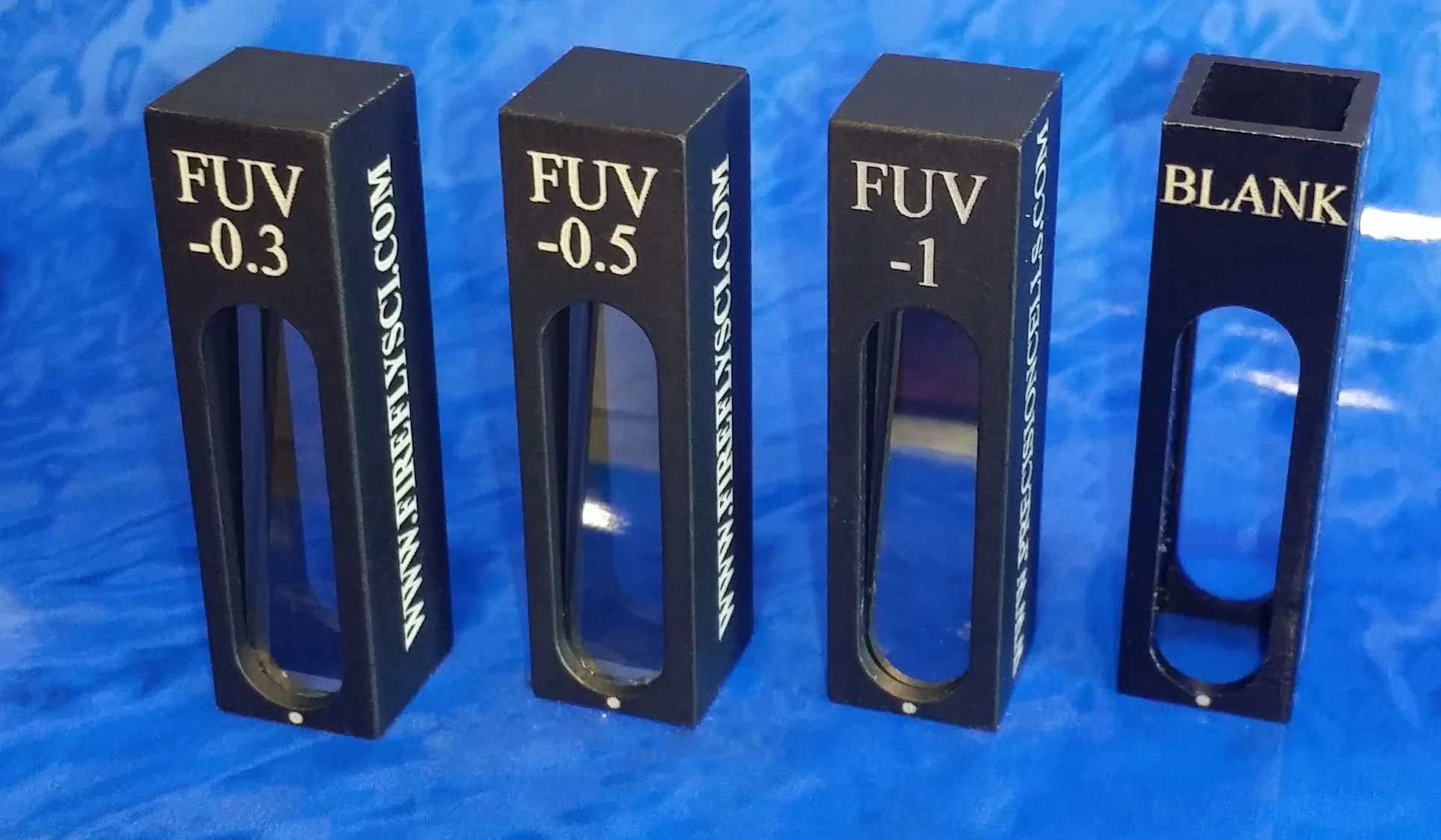
The chamber consisted of a copper block with an opening designed to hold a FireflySci Type 507 Optical Glass Cuvette. A thermoelectric plate attached to the system allowed the researchers to control the sample temperature.
The ferrofluid samples inside the Optical Glass Cuvette contained the nanoparticle-bound fluorescent dye and the freely dissolved fluorescent dye.
Researchers then changed the temperature of the sample through a series of controlled temperature points. At each point, they measured the fluorescence produced by both dyes.
This allowed them to create a calibration showing how fluorescence changed with temperature.
The researchers found a strong linear decrease in fluorescence from both dyes as temperature increased. With those calibration curves established, fluorescence could then serve as an optical thermometer during the team's subsequent nanoparticle heating experiments.
In other words, the Optical Glass Cuvette provided the sample chamber used during an important calibration step. It helped the researchers establish the relationship between temperature and fluorescence before investigating what happened when magnetic nanoparticles were exposed to alternating magnetic fields.

What Did the Team Discover?
The results helped settle an important debate.
The researchers tested several different magnetic nanoparticle compositions. During radio frequency magnetic stimulation, the nanoparticles successfully generated heat.
But the team found no measurable difference between the temperature at the nanoparticle surface and the temperature of the surrounding liquid.
They also investigated ferritin, an iron-containing protein that has been proposed for use in magnetic control of biological processes. Under the conditions tested, ferritin did not produce measurable heating either at its surface or in the surrounding solution.
These findings supported classical heat-transfer theory rather than the idea that substantial amounts of heat remain confined to the immediate nanoscale surroundings of these magnetic particles.
So what about previous experiments that appeared to find nanoscale heat confinement?
The researchers investigated that question too.
Small Measurements, Big Potential for Error
At this scale, the way temperature is measured matters.
The team recreated aspects of previous experimental approaches and identified potential sources of measurement artifacts.
For example, comparing an optical measurement at the nanoparticle surface with a physical temperature probe in the surrounding liquid could make it appear that the particle surface was hotter. The physical probe did not respond to temperature changes in exactly the same way as the optical measurement.
By instead using two fluorescent dyes measured simultaneously with the same optical approach, the researchers were able to make a more direct comparison.
That is an important lesson extending beyond this particular experiment.
When scientists are studying changes occurring at extremely small scales, the experimental setup itself can influence what they appear to observe. Careful sample handling, calibration and optical measurement become critical to separating a real phenomenon from a measurement artifact.
Why Optical Glass Cuvettes Matter in Fluorescence Research
A cuvette may be one of the simpler-looking components in a laboratory optical system, but it occupies an important position: directly between the sample and the light being used to study it.
An Optical Glass Cuvette provides a controlled sample chamber through which excitation and emitted light can pass during compatible spectroscopy experiments.
Depending on the application, researchers may also need to consider factors such as optical path length, sample volume, cuvette geometry, wavelength range and instrument compatibility.
In this experiment, the FireflySci Type 507 Optical Glass Cuvette was incorporated directly into a custom-built temperature-controlled holder. This gave the researchers a practical sample chamber for calibrating the fluorescent temperature probes central to their experiment.
The research is also a good example of how a seemingly small laboratory component can support much larger scientific questions.
From Nanoparticles to the Next Experiment
Scientists continue to push experiments into smaller spaces, from nanoparticles and individual cells to microfluidic devices and organ-on-chip platforms.
As experiments shrink, choosing the right sample container becomes increasingly important. Researchers may need smaller sample volumes, specialized geometries or optical access designed around a particular measurement system.
FireflySci manufactures Optical Glass Cuvettes, micro cuvettes, fluorescence cuvettes and other spectroscopy cells for researchers working across a wide range of applications.
Sometimes advancing science means building a massive new instrument.
Other times, it starts with finding the right little cell to hold your sample.
Looking for an Optical Glass Cuvette for your next experiment? Explore FireflySci's spectroscopy cuvettes or contact us for help finding a cell that fits your application.
Learn More
Research Paper: Hunter C. Davis, Sunghwi Kang, Jae-Hyun Lee, Tae-Hyun Shin, Harry Putterman, Jinwoo Cheon, and Mikhail G. Shapiro. Nanoscale Heat Transfer from Magnetic Nanoparticles and Ferritin in an Alternating Magnetic Field. Biophysical Journal, 2020.