![firefly_logo_FINAL [Black].jpg](https://images.squarespace-cdn.com/content/v1/5411d5c0e4b02e1c8b27565a/1434491508803-XB4OF7YDY46Z72L5U5AP/firefly_logo_FINAL+%5BBlack%5D.jpg)
Catching Atoms With Light: Inside the Magneto-Optical Trap (MOT) Cell
/
you’re as cold as ice!
If your experiment involves slowing atoms down to a crawl, trapping them with light and magnetic fields, and studying what happens when matter gets really cold, there is a good chance a Magneto-Optical Trap (MOT) Cell is somewhere in the setup.
Magneto-optical traps have become an important tool in atomic, molecular, and optical physics. By combining carefully tuned laser light with a spatially varying magnetic field, a MOT can cool and confine neutral atoms, in some cases reaching temperatures in the microkelvin range.
But lasers and magnets are only part of the equation.
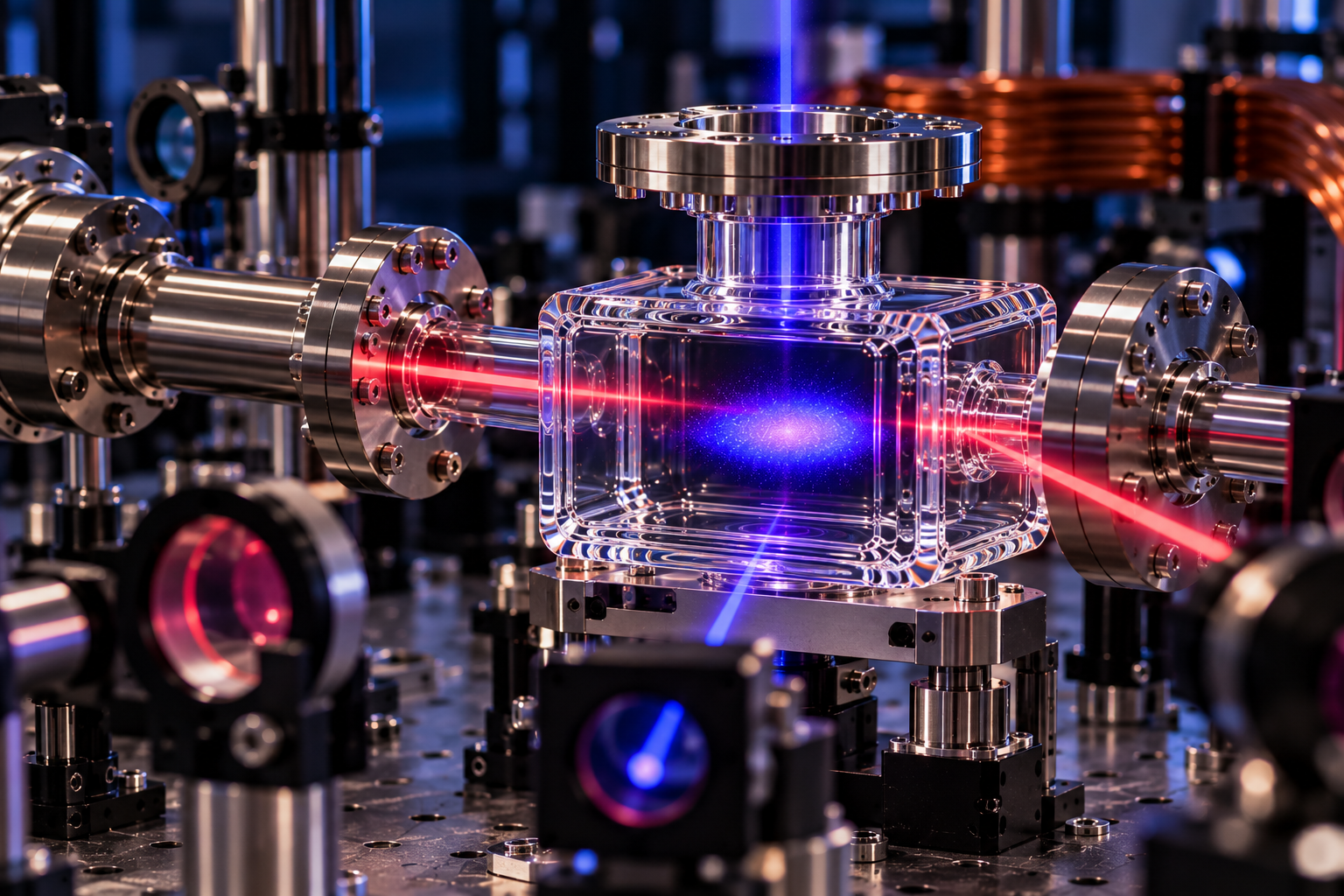
Those atoms need a controlled environment where laser beams can reach the trapping region from multiple directions while the required vacuum conditions are maintained. That is where the MOT cell comes into play.
At FireflySci, we manufacture custom Magneto-Optical Trap (MOT) cells and other specialized vacuum-compatible optical cells for researchers building cold atom, laser cooling, quantum optics, spectroscopy, and related experimental systems.
And because no two experimental setups seem to stay simple for very long, custom configurations are right up our alley.
What Is a Magneto-Optical Trap?
A magneto-optical trap, commonly shortened to MOT, is a system designed to cool and trap neutral atoms using the combined effects of laser light and a magnetic field.
A typical MOT uses three orthogonal pairs of counter-propagating laser beams, giving six beams in total. These beams are generally circularly polarized and red-detuned relative to an atomic transition. A spatially varying quadrupole magnetic field is then centered where the laser beams intersect.
That combination produces something very useful: forces that both slow the atoms down and push them toward the center of the trap.
Think of it as giving an atom two reasons to behave itself.
Laser cooling provides a velocity-dependent damping force, while the magnetic field helps create the position-dependent restoring force necessary for trapping.
The result is a cloud of cold atoms concentrated around the trapping region.
How Does a Magneto-Optical Trap Work?
The physics behind a MOT can get wonderfully complicated, but the basic concept can be broken down into a few key pieces.
1. Start With Moving Atoms
At ordinary temperatures, atoms move much too quickly to simply sit in the middle of an experimental chamber and wait to be studied.
Researchers therefore need a way to reduce their velocity dramatically.
Enter laser cooling.
2. Use Red-Detuned Laser Light to Slow the Atoms
In a MOT, the cooling laser frequency is typically tuned slightly below the relevant atomic resonance, known as red detuning.
Because of the Doppler effect, an atom moving toward an opposing laser beam sees the light shifted closer to resonance. It becomes more likely to absorb a photon from the beam opposing its motion.
When the atom absorbs that photon, it receives a momentum kick in the direction of the laser beam.
In other words, the light pushes against the atom's motion.
The atom subsequently emits a photon through spontaneous emission. Because spontaneous emission occurs in random directions, many absorption and emission cycles can produce an overall damping effect on the atom's motion.
Repeat this process enough times and some very fast atoms become some very slow atoms.
3. Add a Magnetic Field Gradient
Laser cooling alone can slow atoms, but slowing them is not the same thing as keeping them in one place.
For confinement, the MOT introduces a spatially varying magnetic field, commonly a quadrupole field generated using anti-Helmholtz coils. The field approaches zero near the center of the trap and increases as an atom moves away from that center.
Through the Zeeman effect, this magnetic field changes the energy levels of the atom according to its position.
Combined with the appropriate circular polarization of the laser beams, this makes an atom displaced from the center more likely to absorb photons that push it back toward the field zero.
Now the system has both cooling and confinement.
4. Bring Everything Together Inside the MOT Cell
Three pairs of counter-propagating beams typically intersect around the magnetic-field zero. Properly configured, the combination creates a three-dimensional restoring force that confines cold atoms around the center of the system.
And right in the middle of all of this sits the Magneto-Optical Trap (MOT) Cell.
So, What Exactly Is a Magneto-Optical Trap (MOT) Cell?
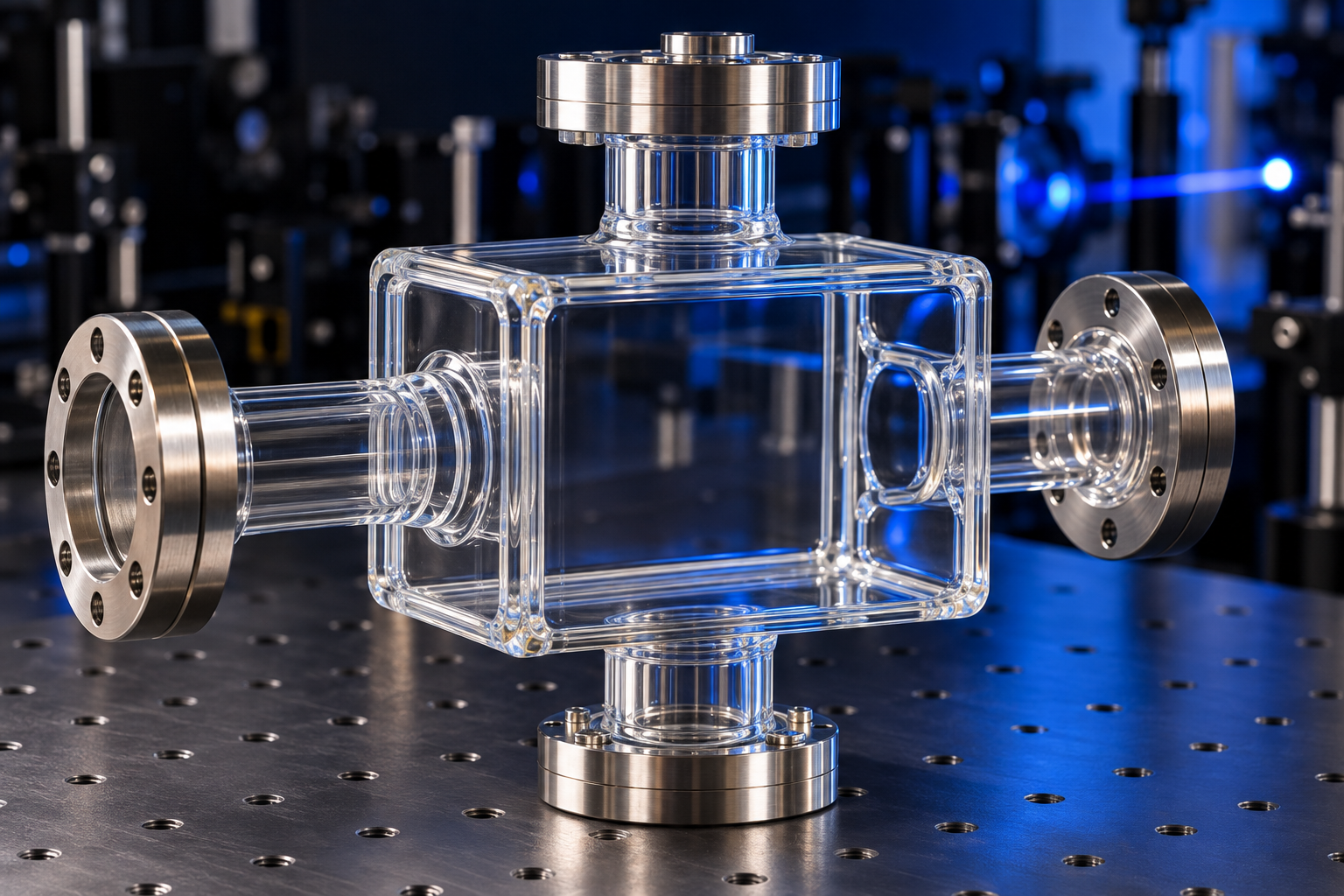
The MOT cell is the physical chamber that provides the controlled environment required for trapping and observing the atoms.
This may look deceptively simple from the outside. A rectangular glass box with a few ports does not exactly scream "quantum physics."
The requirements, however, can be anything but simple.
A MOT vacuum cell may need to provide:
Optical access along multiple axes
Suitable optical transmission at the experiment's laser wavelengths
Vacuum-compatible construction
Low contamination and outgassing characteristics
Ports for connection to vacuum hardware
Connections for atom sources, pumps, gauges, valves, or other components
Carefully controlled dimensions and geometry
Flat optical surfaces where required
Reliable glass-to-glass or glass-to-metal transitions
Compatibility with the researcher's surrounding coils, optics, mounts, and instrumentation
MOT cells are commonly produced as rectangular glass chambers with vacuum connections for atomic physics applications.
But that does not mean your experiment has to fit somebody else's box.
That is where custom manufacturing becomes particularly useful.
Why Optical Access Matters in a MOT Cell
A MOT relies heavily on geometry.
With six laser beams commonly approaching the trapping region along three perpendicular axes, researchers need clear optical paths through the chamber.
The cell walls are not simply there to hold vacuum. They are part of the optical system.
Poorly suited windows or cell geometry can introduce unwanted reflection, refraction, scattering, clipping, or distortion. Window placement can also determine whether beams can reach the intended trapping region while leaving enough physical space for magnetic coils and surrounding optics.
For custom MOT cells, dimensions therefore need to be considered as part of the entire experimental layout.
That can include the chamber's:
Overall length, width, and height
Internal volume
Window dimensions
Optical path locations
Wall thickness
Port position and orientation
Tube diameter and length
Flange or seal requirements
Distance between the trapping region and surrounding hardware
This is one of those applications where a few millimeters can make the difference between "perfect fit" and "back to the drawing board."
FireflySci already works extensively with optical cells where precise positioning of the light path relative to the cell geometry is critical. Window position, base thickness, beam height, and other physical dimensions can all play a major role in whether an optical cell works correctly with the surrounding equipment.
The equipment may be different, but the underlying manufacturing lesson is the same: optical geometry matters.
Maintaining Vacuum Conditions Inside a MOT Cell
Cold atom experiments generally require vacuum conditions so that trapped atoms are not constantly colliding with background gas molecules.
In sufficiently high vacuum, the mean time between disruptive collisions increases, allowing atoms to remain trapped long enough to perform measurements and subsequent experimental sequences.
Some cold atom systems operate in ultra-high-vacuum environments, and MOT chambers can be integrated with pumping systems, atom sources, valves, gauges, and additional vacuum components depending on the experiment.
FireflySci manufactures cells for demanding vacuum applications, including custom configurations intended for specialized UHV and cryogenic research.
That experience gives researchers another option when a standard laboratory cell simply will not cut it.
Materials for Custom MOT Cells
Material selection is another major consideration when designing a Magneto-Optical Trap (MOT) Cell.
There is no universal "best" material for every experiment. The correct choice depends on optical wavelength, thermal requirements, fabrication geometry, vacuum interfaces, and other experimental conditions.
Borosilicate and Pyrex-Type Glass
Borosilicate glass is frequently used for MOT chambers because it combines useful optical properties with good thermal stability and glass fabrication characteristics.
FireflySci has extensive experience working with Pyrex-type borosilicate materials. These materials can be particularly useful when additional structures, vacuum connections, graded seals, or adapters need to be incorporated into a custom cell.
Those fabrication characteristics can become especially valuable when a custom cell needs to connect the optical chamber to a larger vacuum system.
Fused Silica and Quartz
Quartz and fused silica can be useful where experiments require broader optical transmission, different thermal properties, or specialized optical performance.
FireflySci works extensively with high-purity fused silica for applications requiring excellent optical transmission, chemical resistance, low thermal expansion, and demanding temperature conditions.
The exact material used for a custom MOT cell should ultimately be selected according to the wavelengths, temperature conditions, vacuum requirements, joining requirements, and geometry of the experiment.
Tell us what your experiment needs to do, and we can work backward from there.
What Can Be Customized on a FireflySci MOT Cell?
This is where things get interesting.
Researchers rarely build identical cold atom experiments, so FireflySci can work with customers on a custom Magneto-Optical Trap (MOT) Cell designed around the requirements of the setup.
Depending on the design and manufacturing feasibility, specifications can include:
Cell Geometry: Rectangular, square, tubular, or other specialized chamber geometries can be evaluated based on your experimental requirements.
Overall Dimensions: Specify the dimensions required to fit between coils, optical mounts, vacuum components, and surrounding hardware.
Optical Windows: Window size, location, material, and optical requirements can be incorporated into the design.
Ports and Tubulations: Custom tubes and connections can be positioned according to the vacuum layout and experiment geometry.
Vacuum Interfaces: The cell can be designed around required vacuum connections, graded seals, or compatible interfaces where appropriate.
Material Selection: Depending on the application, different glass and fused-silica materials can be considered.
Optical Coatings: Specialized optical coatings can be evaluated according to the requirements of the experiment.
Stock Cell Modifications: Sometimes you do not need to reinvent the wheel. Existing cell designs may provide a useful starting point for a custom configuration.
The goal is simple: build the cell around the experiment instead of forcing the experiment around the cell.
What Are Magneto-Optical Traps Used For?
Once atoms have been cooled and trapped, researchers have an extraordinarily useful starting point for further experiments.
Magneto-optical trapping and laser cooling techniques are used throughout modern atomic physics and related research, including work involving:
Cold and ultracold atoms
Atomic spectroscopy
Quantum optics
Precision measurement
Atom interferometry
Optical lattices
Quantum sensing
Atomic clocks
Fundamental physics experiments
Bose-Einstein condensate research
Development of quantum technologies
A MOT is also frequently an early stage rather than the final destination. Cold atoms captured in a MOT can subsequently be transferred into magnetic, optical, or other trapping configurations for additional cooling and experimentation.
So while the MOT may only be one part of the experimental sequence, it can be a pretty important part.
Why Custom MOT Cell Geometry Matters
Imagine designing an entire optical table around a cell only to discover that one vacuum tube sticks directly into the space reserved for a magnetic coil.
Not ideal.
Custom MOT cell manufacturing gives researchers the ability to consider the chamber as part of the complete system from the beginning.
Before requesting a custom cell, it is useful to consider:
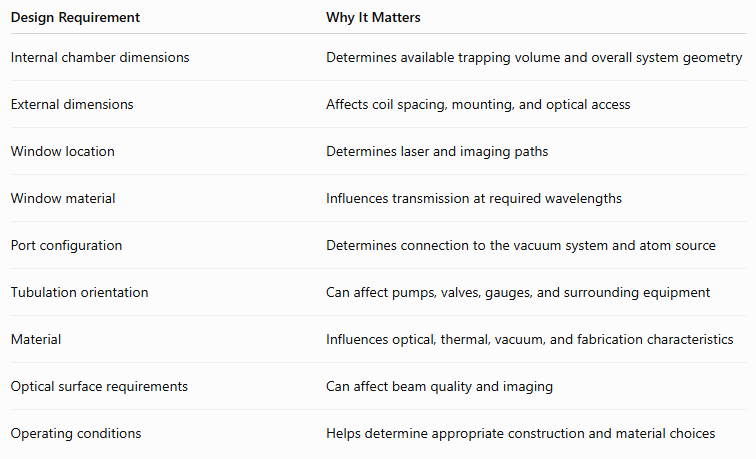
The more information available at the quotation stage, the easier it is to evaluate the design for manufacturability.
A drawing is even better.
We like drawings.
Stock UHV Cells for Related Vacuum Experiments
Not every experiment requires a fully custom MOT chamber.
FireflySci also offers a selection of stock UHV cells that may work for related vacuum, spectroscopy, fluorescence, atomic physics, and experimental applications.
These stock configurations can also provide a useful starting point when determining whether your experiment requires a completely custom MOT cell.
Browse FireflySci UHV Cells:
https://www.fireflysci.com/uhv-cells
If one of our stock cells gets you most of the way there, contact us to discuss whether a custom or modified configuration makes more sense.
Custom MOT Cells From FireflySci
A Magneto-Optical Trap (MOT) Cell has a deceptively difficult job.
It needs to maintain the environment required for atomic trapping while giving lasers, imaging systems, magnetic fields, vacuum hardware, and the rest of your experimental setup room to do their jobs.
That combination makes MOT cells a natural candidate for custom manufacturing.
FireflySci works with researchers who need optical cells beyond ordinary catalog configurations. Our custom manufacturing capabilities cover specialized glass and quartz cells, vacuum-compatible components, fused-silica designs, custom geometries, optical interfaces, and other components built around demanding experimental requirements.
If you already have a drawing for your MOT cell, send it our way.
If you have dimensions, material requirements, vacuum connections, laser wavelengths, and a sketch that looks like it was drawn on the back of a napkin, send that too.
We'll help you determine the next step.
Need a Custom Magneto-Optical Trap (MOT) Cell?
Whether you are building a new cold atom experiment, replacing an existing chamber, or designing something that simply does not exist in a catalog, FireflySci can work with you on a custom Magneto-Optical Trap (MOT) Cell built around your application.
Have your specifications ready? Send us your drawings, dimensions, material requirements, optical requirements, and vacuum interface details for review.
For experiments that may not require a completely custom MOT chamber, be sure to check out our stock UHV cells as well:
https://www.fireflysci.com/uhv-cells
Because when you are trying to control atoms with lasers at microkelvin temperatures, your glass cell should probably be the easy part.
Here's to your success!
FireflySci, Inc.